logo_RMSI
Global

Modeling & Analytics

Trusted Analytics for a Resilient World

RMSI delivers advanced Modeling & Analytics services that help organizations understand, quantify, and manage risk. We develop sophisticated hazard models for risk pricing, insurance design, and multi-hazard forecasting. Our vulnerability models assess physical, economic, and social impacts to support effective disaster preparedness and resilience planning. We have three decades of experience in risk modeling across sectors with a focus on urban, agricultural, flood, and windstorm hazards. Our machine learning analytics automate feature extraction from spatial, imagery, and text data—uncovering critical insights. We also provide predictive analytics for utilities, enabling proactive maintenance and real-time issue detection. From risk mitigation to net-zero support, RMSI delivers the intelligence for confident, data-driven decisions.

Our Services

Hazard Models

RMSI has core competence in creating computer-based hazard models by combining statistical, numerical and machine learning based techniques and incorporating those hazard models into software solutions to solve real life problems such as risk pricing, insurance product design, treaty structuring, multi-hazard forecasting, early warning systems, cost-benefit analysis for mitigation, net-zero analytics, and resilience assessment for physical and transition risks.”

The output of the model analyses is in the form of return period maps, stochastic event hazard maps that visualize hazard intensity of all areas, and deterministic hazard maps of specific hazard events or live events.

  • Base models (Numerical models): These are physics-based deterministic models that simulate specific catastrophic events using historical and scientific data. They provide detailed impact analysis for known scenarios and serve as a foundation for validating risk assumptions.
  • Stochastic models –  These probabilistic models produce thousands of synthetic events, including rare and extreme scenarios. They assist in the quantification of uncertainty, frequency, and severity by simulating the randomness of events over extended return periods.
  • Amalgamated models  – These hybrid models integrate real-world data with outputs from deterministic and stochastic frameworks. They enhance accuracy by learning from past losses and exposure characteristics through the use of AI/ML.

Vulnerability Models

RMSI develops vulnerability models that are designed to quantify and contextualize susceptibility, enabling better preparedness, mitigation, & response strategies.

Our comprehensive vulnerability models estimate the physical, economic, and social consequences of disasters across multiple domains, enabling decision-makers for governments, multilaterals, disaster risk agencies and private enterprises.

  • Building/Structural Vulnerability: 
    We assess the hazard and vulnerability impact of key residential, commercial, and public buildings.  
  • Population Vulnerability : We model total population at risk, potential casualties (lives lost) and injured casualties
  • Social Vulnerability: Identify at-risk populations based on socio-economic indicators such as income, education, age, access to services, eating habits, culture, and habitats

  • Economic Vulnerability: is a combination of various above risks combined together to give an overall economic risk.

  • Agricultural Vulnerability: Our models estimate crop behaviour patterns.

  • Connected Vulnerability: Modern systems are interconnected—so vulnerabilities in one area can cascade across others.

Risk Models

RMSI has three decades of experience in building NAT CAT (natural catastrophic) models and applying them for risk analysis. We have developed risk models for more than 30 countries covering all major hazards of the world. Our models are applied for mitigation and preparedness planning, insurance and reinsurance risk assessment. 

We define risk as a function of three core components: HazardVulnerabilityResilience

Output – We are equipped to understand how various input parameters affect risk estimation. By analyzing these components together, we quantify risk in multiple, decision-relevant ways:

  • Risk outputs include: Monetary Loss, Index Value (Deterministic risk), and Social Risk Metrics (No of people looking for shelter), Fiscal losses (Compensations)
  • Applications: Disaster Planning, Insurance & Reinsurance, Urban Infrastructure, and Public Finance
  • Supports decision-making for governments, multi-lateral agencies, and private enterprises

ML Based Analytics

Harness the power of machine learning to transform your raw data into actionable intelligence. 

Feature Extraction: Automated extraction of high-value spatial and structural features from imagery and GIS data. We specialize in identifying:

  • Point features for infra analysis and spatial planning
  • Building footprints for urban planning and asset management
  • Road entry points for traffic flow and logistics optimization
  • River channels for hydrological modeling and risk mitigation
  • Sub-set extractions that let you isolate specific regions, features, or patterns within large datasets, drastically reducing manual processing time.

Text-Based Extraction: Convert unstructured documents into usable data with our text-based analytics services. Ideal for:

  • Paper-based record digitization for efficient archival and search
  • Easement mapping for legal and property insights
  • Insurance documentation analysis for faster claims and compliance workflows

Predictive Analytics for Utilities

Modern utilities are rapidly adopting AI-driven predictive analytics to proactively monitor and maintain infrastructure. By leveraging real-time data from IoT sensors, utilities can detect potential issues before they occur—minimizing downtime, enhancing safety, and improving operational efficiency, allowing utilities to minimize downtime and resolve issues proactively.

  • Predictive Maintenance: Analyzing sensor data from equipment (e.g., power lines, transformers, pipelines), to predict potential failures before they occur, reducing repair costs, and extending the lifespan of equipment.
  • Demand Forecasting: Accurately predict energy needs using historical usage patterns, weather forecasts, and other relevant factors.
  • Outage Management: By analyzing data from smart meters and other sensors, utilities can predict the location and potential impact of outages for faster response times, targeted repairs, and better communication with affected customers.
  • Customer Behavior Insights: Understand customer usage patterns and demographics to enhance service, personalize offerings, and develop targeted marketing campaigns.

Success Stories

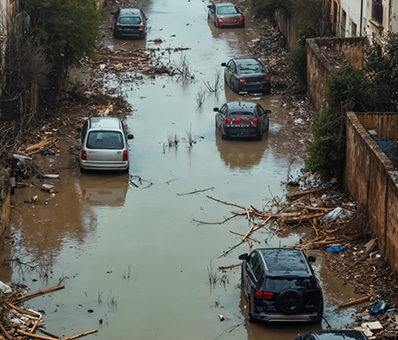
Flood Vulnerability Assessment of Four Agglomerations in Gujarat

Flood Vulnerability Assessment of Four Agglomerations in Gujarat

Undertaking a micro-level flood vulnerability assessment study of four major cities of Gujarat up to the ward level and providing recommendations to help reduce or eliminate flooding vulnerability risks within the study areas...

Read More arrow-black
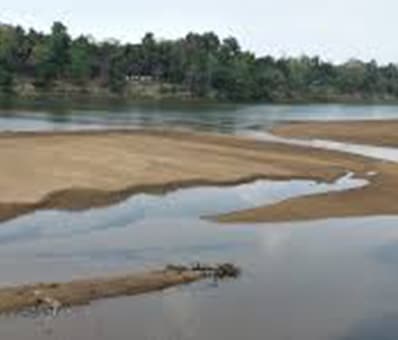
Building Resource Management System and Community-based Disaster Risk Reduction in the Kopili River Basin

Building Resource Management System and Community-based Disaster Risk Reduction in the Kopili River Basin

Development of an Early Warning System (EWS) for Flood Preparedness in the Kopili River Basin...

Read More arrow-black
Assessing Climate Vulnerability & Risk Across Seven Airports in India

Assessing Climate Vulnerability & Risk Across Seven Airports in India

The client is a leading private airport operator in India. The objective of the project was to assess climate vulnerability and risk across seven major airports...

Read More arrow-black

Let’s Talk About Your Needs

En