
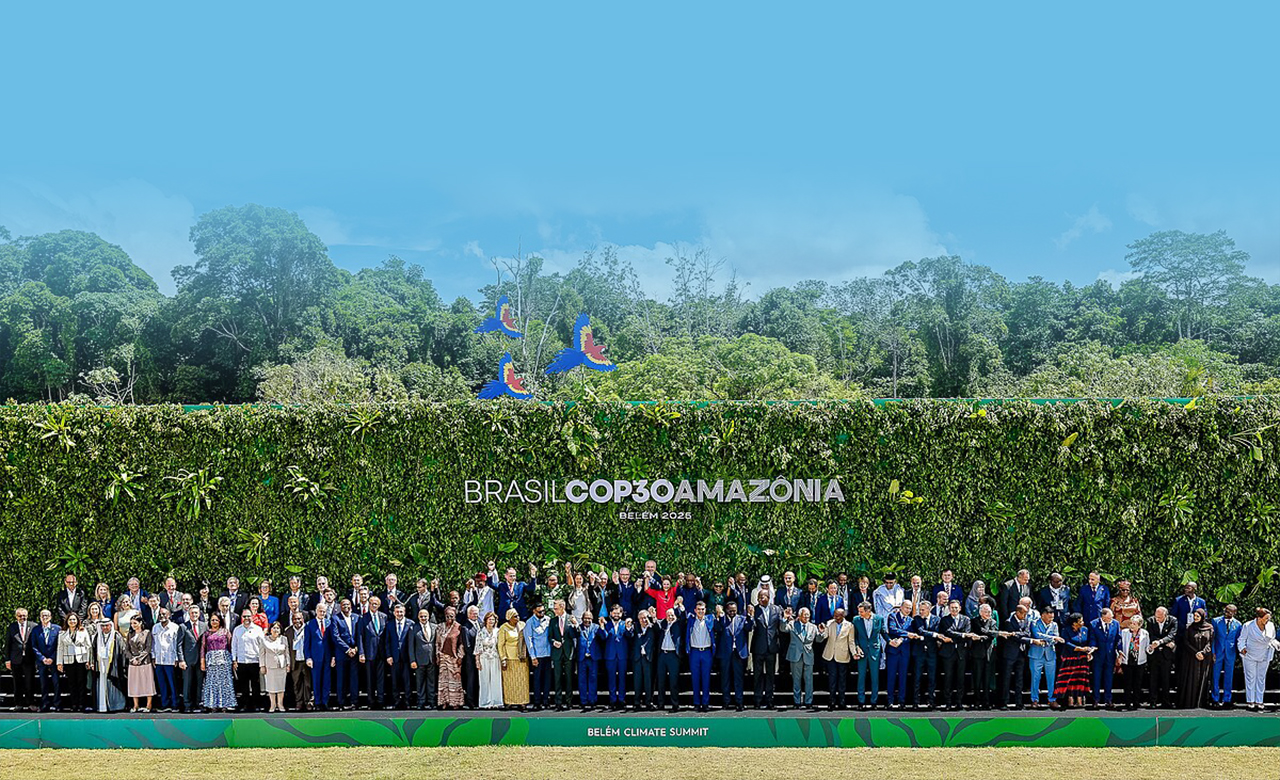
Climate Change remains the epitome of all global challenges facing the world today but climate negotiations are fogged by uncertainty, protests, disillusionment with the multilateral system, dishonour of finance and technology commitments by developed countries and a rapidly declining carbon budget. The Conference of Parties-30 (COP30) to the United Nations Framework Convention on Climate Change (UNFCCC) took place from 10th – 21st November, 2025 at Belém, Brazil. The COP30 climate talks concluded with countries agreeing on a goal to “triple” adaptation finance by 2035 and efforts to “strengthen” climate plans after two weeks of negotiations and hectic discussions. However, a decision that will have any significant bearing on the effectiveness of global action to fight climate change is still missing. This COP could definitely be better in delivering the commitment “Implementation COP” where countries would advance on their collective decisions to limit temperature rise to the Paris target of 1.5oC (there is no path to meeting the Paris targets without almost entirely phasing out fossil fuels). Although some carbon removal is possible thanks to a plethora of nature-based and technological fixes, from reforestation and regenerative farming to carbon capture, this capacity is nowhere near enough to offset the emissions of unchecked fossil fuel use. Thanks to all the policies enacted and advances in clean energy over the last decade, we’re currently heading towards a world that’s 2.8oC warmer. And if all of the countries’ Nationally Determined Contributions are implemented, the warming will be around 2.4oC. It was also noted that there could not be a uniform phase-out plan for everyone, and that countries should be free to decide on their own pathways for eliminating fossil fuels in their national interest.
The conference venue highlighted the growing challenges of hosting large-scale global events in a changing climate. Periods of heavy rainfall resulted in water ingress, while high heat and humidity placed additional strain on indoor climate systems—conditions that are expected to intensify as climate impacts accelerate. On 20 November, a fire incident within the convention hall led to a precautionary evacuation of the blue zone and a temporary pause in proceedings. The situation was quickly brought under control, with no serious injuries reported, underscoring the importance of climate-resilient infrastructure and adaptive planning in a warming world.
The showpiece outcome from COP30, being referred to as a political package, has taken on board two big issues flagged by the developing countries — implementation of a key finance provision in Article 9.1 of Paris Agreement, and unilateral trade measures like EU’s Carbon Border Adjustment Mechanism (CBAM) — though not in the same way as was being demanded.
The final deal “fell short on the global transition away from oil, gas and coal”, as Brazil announced that it would bring forward voluntary roadmaps to phase out fossil fuels and deforestation, before the next COP. It was a “frustrating end” for more than 80 countries who wanted a roadmap away from fossil fuels to be part of the formal COP agreement. The agreement completely left out a fossil fuel exit roadmap, which the European Union, some Latin American countries and small island nations had been pushing hard for and the roadmap on fossil fuel phase-out did not find a place in the final outcome. A statement however was included to ensure that the trust in this negotiating process was not further eroded after the withdrawal of the United States from the Paris Agreement by reposing their faith in this UN-mandated process.
The key outcomes from COP30, spanned from negotiations on adaptation including Loss and Damage Funds, forest protection, gender and “Article 6” carbon trading through to a round-up of pledges on various issues.
The key highlights include:
- Loss and damage caused by climate-related disasters in developing countries featured in multiple COP30 negotiating tracks, with the focus restricted to technical and procedural matters which has long been a fraught topic at UN climate talks. An action plan was also agreed to enable better evaluation of global progress to implement ecosystem-based adaptation and enhance the resilience of ecosystems, cultural heritage, biodiversity and on the Baku Adaptation Roadmap to accelerate adaptation action by tripling of adaptation finance funds by 2035 and urging developed countries to do their part, as a key enabler of action in developing countries facing increasing climate impacts.
- At COP30, South Korea (which operates the world’s seventh-largest fleet of coal plants) committed to closing all 40 plants by 2040 and build no new unabated plants. This makes South Korea the second Asian nation, after Singapore, to join the Powering Past Coal Alliance, launched in 2017 at COP23 in Germany.
- The mitigation work programme outcomes emphasized the importance of country-specific mitigation action in the forest sector, underscoring forests and mangroves as important carbon stocks and sinks. The Governor of the State of Pará, where Belém is located, committed to tagging all 20 million cattle in the region to track deforestation to ensure no deforestation is linked to beef production. The launch of the Tropical Forest Forever (TFF) fund backed by $5.5 billion in initial commitments (Brazil and Germany each have pledged $1 billion, with Norway promising $3 billion), aims to curb deforestation by rewarding countries that keep their forests intact.
- At COP30, a bloc of oil-producing nations led by Petro-States and including Saudia Arabia and Russia prevented agreement on phasing out fossil fuels — and without that, we can’t meet Paris goals. However, Colombia and the Netherlands announced the first International Conference on the Just Transition Away from Fossil Fuels, to be held in Colombia in April 2026. “There is a clear momentum to phase out fossil fuels, and demonstrates that progress is possible—and that every action to move beyond fossil fuels brings us closer to ensuring a liveable future.
- Many had expected COP30 to have a stronger focus on agriculture and food than previous years. During the world leaders’ summit in the days before the official start of negotiations, 43 countries and the EU adopted the Belém declaration on hunger, poverty and human-centred climate action. As a show-case, it was stated that by shifting from livestock to plant-based agroforestry (uses 12 times less land and creates 4 times more jobs, Brazil could deliver 5% of its NDC target by restoring degraded pastures. Also, proven measures across energy, agriculture, and waste could unlock 80% of methane mitigation potential at low cost and prevent 180,000 deaths annually. However, formal negotiations for agriculture and food systems at the UNFCCC fall under the Sharm el-Sheikh joint work on the implementation of climate action on agriculture and food security (SJWA). Thus, COP30 ended without a substantive outcome and noted that more time is needed to conclude the discussions thereon.
- For the first time in a COP text, it acknowledges that there is likely to be an “overshoot” of 1.5oC, saying that both the extent and duration of this needs to be “limit[ed]”. It responds to this by launching two ill-defined voluntary initiatives, led by the COP presidencies: a “global implementation accelerator” (GIA) and a “Belém mission to 1.5oC”.
- Again, for the first time, labour rights, human rights, the right to a clean environment, ‘free, prior and informed consent’ and the inclusion of marginalised groups were all recognised as core to achieving more ambitious climate action.
The year 2025 was particularly key for countries’ climate pledges, as it was the deadline to submit new “nationally determined contributions” (NDCs) to the UN. These plans outline countries’ ambitions for slashing emissions out to 2035. Countries were meant to submit new NDCs to the UN by 10 February, but 95% of countries missed that deadline. The latest round of NDCs will cause global emissions to drop 10% by 2035 from 2019 levels, “bending the emissions curve downwards for the first time”, but falling “drastically short” of the 60% cut needed to keep 1.5C in sight. A decade on from the Paris Agreement, there is now a growing sense that COPs are disconnected from real-world climate action.
Speaking at the summit, UN secretary-general António Guterres described countries’ failure to keep global temperatures from crossing 1.5oC as a “moral failure and deadly negligence”. He further stated that “Every fraction of a degree means more hunger, displacement and loss – especially for those least responsible.”
The world was looking to this COP to demonstrate continuity and progress after “the Global Stocktake” and should not inevitably be seen as a step backward. The “compromise” COP30 deal – known as the “global mutirão” – “exposed deep rifts over how future climate action should be pursued (“mutirão“ is a Portuguese word originating in the Indigenous Tupi-Guarani language that refers to people working together towards a common aim with a community spirit – something the COP30 presidency was keen to emphasise). The “last-ditch” agreement was reached after fossil-fuel wording negotiations between the EU and Saudi Arabia. As many as 84 countries are said to have “opposed” the inclusion of a fossil-fuel roadmap in the mutirão decision. The follow-up initiatives will be key spaces for the COP Presidency to lead the dialogues and develop roadmaps to transition away from fossil fuels and halt deforestation by 2030 (since there was no agreement to develop them within the Mutirão decision itself).
It was agreed at COP30 that Turkey will act as host to COP31 next year and “COP31 president”, while Australia will be “president of negotiations”. It was also agreed that COP32 will be held in Addis Ababa, Ethiopia in 2027. This will be the first-ever COP hosted by one of the least-developed countries.