
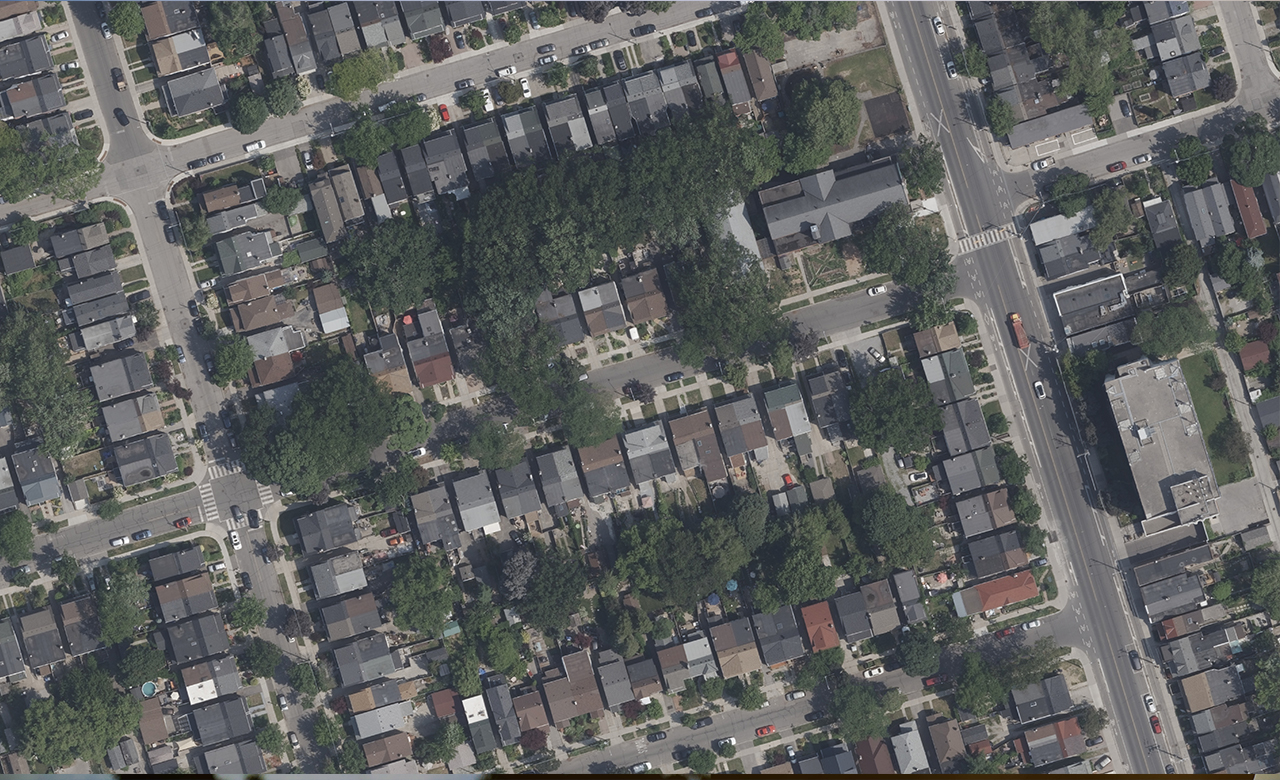
As Artificial Intelligence continues to power decision-making across industries, one factor consistently determines its success- the quality of training data. From geospatial intelligence and infrastructure monitoring to agriculture and autonomous systems, AI models rely heavily on how accurately the real world is represented in their training datasets.
At the core of this liesimage segmentation, the process of identifying and labeling objects within imagery and spatial data. Whether working with satellite images, aerial photography, or LiDAR point clouds, segmentation defines how effectively AI can “see,” interpret, and act on data. Without high-quality 2D and 3D training data, even the most advanced algorithms fail to deliver reliable outcomes.
What High-Quality 2D and 3D Training Data Means
Training data for AI typically comes in two forms-2D and 3D, each playing a distinct but complementary role in building intelligent systems.
2D data includes satellite imagery, aerial images, and street-level visuals where objects are annotated at pixel or object level. This enables AI to identify features such as roads, buildings, crops, and land use patterns.
3D data, on the other hand, introduces depth and spatial structure using technologies like LiDAR, digital elevation models, and 3D representations of environments. This allows AI to understand not just what objects are, but also where they exist in space and how they relate to each other.
High-quality training data is defined by:
- Accurate and consistent annotation
- Clear object boundaries and classifications
- Contextual understanding of spatial relationships
- Integration of multiple data sources (imagery, elevation, point clouds)
Together, these elements transform raw data into actionable intelligence.
Why High-Quality Training Data Is Necessary
Utilizing high quality training data is highly necessary, listed below are a few pointers to understand why.
It Directly Impacts Model Accuracy
AI models fundamentally rely on learning patterns from labeled datasets. The quality of segmentation—how accurately objects are identified and classified—directly determines how well a model performs in real-world scenarios. If annotations are inconsistent, incomplete, or incorrect, the model internalizes those inaccuracies, leading to compounding errors over time.
For example, a poorly segmented dataset may cause confusion between similar features (such as different land types or infrastructure elements), reducing the model’s ability to distinguish critical differences. This not only affects prediction accuracy but also limits the model’s ability to generalize across varied conditions and datasets.
High-quality training data ensures that AI systems are trained on precise, reliable representations of real-world environments, enabling them to deliver consistent and trustworthy outputs.
High-quality datasets ensure:
- Precise object detection and classification
- Better performance across diverse geographies and conditions
- Reduced need for rework, retraining, and manual corrections
It Enables Scalable AI Deployment
As organizations expand AI applications across regions, use cases, and asset types, scalability becomes a key challenge. AI models trained in inconsistent or poorly structured data often fail when applied to new geographies or datasets, requiring additional tuning and delaying deployment.
Standardized annotation frameworks and well-structured datasets enable models to scale seamlessly across large and diverse environments. This is particularly critical in geospatial and infrastructure applications, where data is sourced from multiple platforms such as satellite imagery, aerial surveys, and LiDAR.
High-quality training data ensures consistency in how features are identified and labeled, allowing AI systems to operate reliably across different contexts without significant reconfiguration.
High-quality data supports:
- Large-scale mapping and feature extraction across geographies
- Seamless integration of multi-source datasets and systems
- Faster and more efficient deployment of AI-driven solutions
It Brings Context to Complex Environments
Real-world environments are rarely simple or static. Industries such as agriculture, infrastructure, and environmental monitoring operate within highly dynamic ecosystems where multiple variables interact simultaneously. AI systems must therefore move beyond basic detection to develop a deeper understanding of spatial relationships, patterns, and temporal changes.
High-quality 2D and 3D training data provides this critical context. By combining imagery with elevation data and spatial attributes, AI models can interpret not just individual objects, but also how they relate to their surroundings. This enables more meaningful insights such as identifying patterns in crop health, detecting structural changes in infrastructure, or analyzing terrain variations.
Without this level of contextual richness, AI outputs remain surface-level and lack actionable value.
Well-annotated 2D and 3D data enables:
- Advanced spatial analysis of terrain, assets, and environments
- Identification of subtle variations (e.g., crop stress, structural shifts)
- Context-aware and insight-driven decision-making
It Reduces Risk in Critical Applications
AI is increasingly being deployed in mission-critical applications where accuracy and reliability are essential. In such scenarios, even minor errors in data can lead to significant consequences—ranging from operational inefficiencies to financial losses or safety risks.
Poor-quality training data introduces uncertainty into AI models, making their outputs less predictable and harder to trust. This is particularly problematic in applications involving large-scale infrastructure, environmental monitoring, or automated decision-making systems.
High-quality datasets mitigate these risks by ensuring that models are trained on accurate, validated, and consistent data, resulting in more dependable outcomes. This builds confidence among stakeholders and supports the adoption of AI in high-impact use cases.
Reliable datasets help:
- Improve confidence in AI-driven insights and outputs
- Minimize errors and inconsistencies during deployment
- Support informed and critical decision-making processes
What is the Impact Across Key Applications?
The implementation of high-quality data training impacts significantly in multiple aspects, listed below are the areas where it sends in the right impact-
Mapping and Geospatial Intelligence
High-quality segmentation plays a foundational role in transforming raw geospatial data into meaningful insights. By accurately identifying and classifying features such as roads, buildings, vegetation, and land cover, AI models can generate highly reliable spatial datasets. When this segmentation is combined with multi-source geospatial inputs—such as satellite imagery, aerial surveys, and elevation data—it enables a much more comprehensive understanding of the physical environment.
This level of precision is critical for applications that depend on up-to-date and scalable mapping. It allows organizations to continuously update maps, monitor changes, and derive insights that support planning and operational efficiency. Moreover, accurate geospatial intelligence enables better alignment between data and real-world conditions, ensuring decisions are grounded in reality.
High-quality segmentation enables:
- Creation of precise, dynamic, and up-to-date maps
- Large-scale spatial analysis across regions and terrains
- More effective planning, resource allocation, and decision-making
Infrastructure Intelligence
Infrastructure systems are complex, distributed, and constantly evolving. AI models trained in high-quality 2D and 3D data can accurately identify, classify, and monitor a wide range of assets from transportation networks to utilities and built environments. The precision of segmentation ensures that each asset is clearly defined and understood within its spatial context.
Over time, these models can detect changes, enabling continuous monitoring of infrastructure conditions. This is essential for identifying potential risks, planning maintenance activities, and optimizing asset performance. The inclusion of 3D data further enhances this capability by providing depth and structural context, allowing for a more detailed understanding of asset geometry and spatial relationships.
This combination of accuracy and context enables organizations to move from reactive to proactive infrastructure management.
AI-driven infrastructure intelligence enables:
- Accurate asset detection and classification across large networks
- Change detection and temporal analysis for ongoing monitoring
- Improved maintenance planning, lifecycle management, and risk assessment
3D data adds an additional layer of value by enabling:
- Detailed understanding of structural dimensions
- Enhanced spatial analysis of complex environments
- More robust and reliable infrastructure insights
Agriculture and Environmental Monitoring
Agriculture and environmental systems are influenced by a wide range of dynamic factors, including weather, soil conditions, and land use patterns. High-quality training data enables AI models to accurately interpret satellite and aerial imagery, turning visual inputs into actionable insights.
Through precise segmentation, AI can identify crop types, monitor growth patterns, and delineate field boundaries with high accuracy. It can also detect subtle variations in vegetation health or environmental conditions that may not be visible to the human eye. This allows for early identification of potential issues and more informed decision-making.
When combined with spatial analytics and temporal data, these insights can be scaled across regions, supporting large-scale agricultural monitoring and environmental assessment.
High-quality data enables:
- Accurate crop identification and continuous monitoring
- Precise field boundary mapping and land-use classification
- Detection of environmental changes and emerging patterns
Integrated insights support:
- Data-driven agricultural planning and optimization
- Improved resource utilization
- Scalable monitoring across large geographies
Autonomous Systems and Computer Vision
Autonomous systems rely on real-time interpretation of their surroundings to function effectively. Whether navigating physical environments or analyzing visual data, these systems depend heavily on the quality of their training datasets. High-quality segmentation ensures that AI models can accurately identify objects, understand spatial depth, and interpret complex scenes.
Inaccurate or inconsistent training data can lead to misinterpretation of objects or environments, significantly impacting system performance. In contrast, well-annotated 2D and 3D datasets enable AI systems to respond more reliably to real-world conditions, improving both efficiency and safety.
This is particularly important in applications where rapid decision-making is required, and errors can have significant consequences.
High-quality segmentation enables:
- Improved object detection and detailed scene understanding
- Accurate depth perception and spatial awareness
- Enhanced navigation, responsiveness, and decision-making
Ultimately, this leads to:
- Safer and more reliable autonomous system deployments
- Greater confidence in AI-driven operations
Conclusion
High-quality 2D and 3D training data is not just an input, it is the foundation of scalable and reliable AI. Accurate image segmentation ensures that AI systems can interpret the real world with precision, enabling meaningful insights across industries. As organizations continue to adopt AI at scale, investing in structured, well-annotated, and context-rich datasets will be critical. Those who prioritize data quality and integrated geospatial intelligence will be better equipped to unlock the full potential of AI-driving smarter decisions, reduce risk, and deliver measurable impact.