
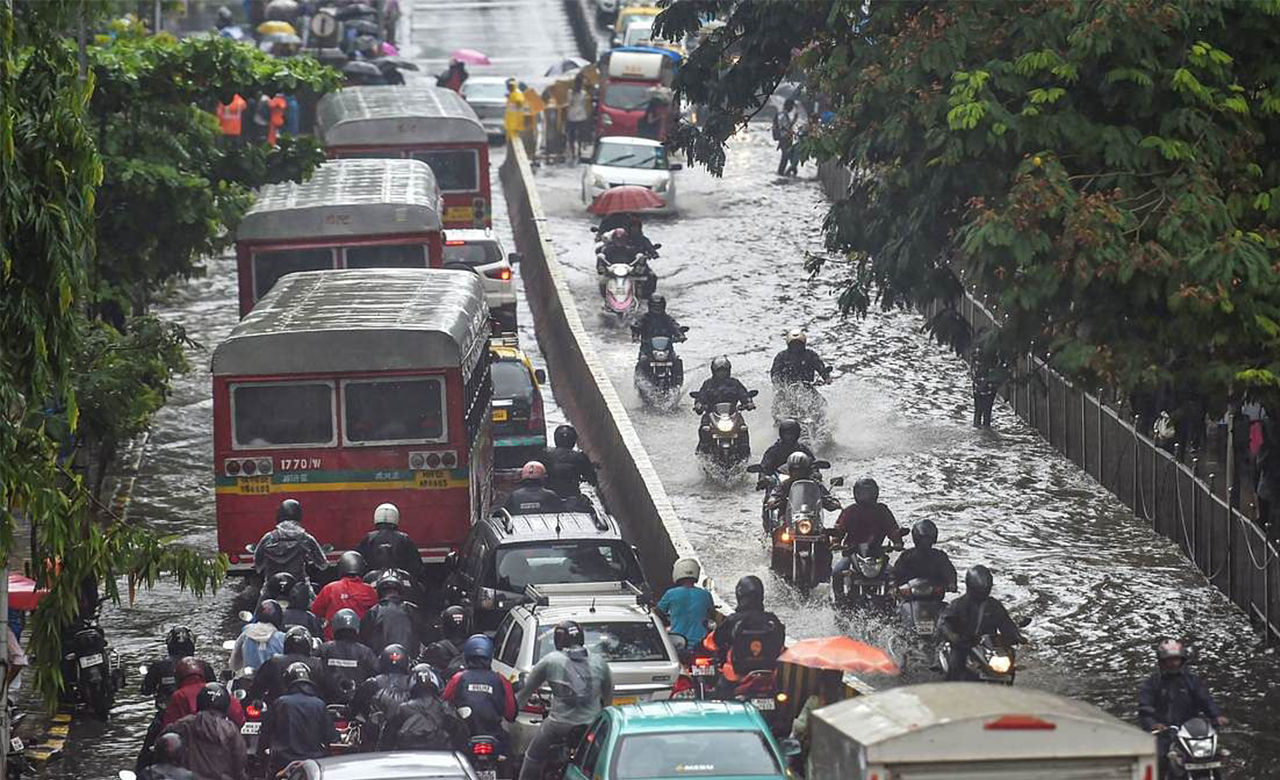
Barely a week after Mumbai recording its worst condition of water availability in reservoirs in years, grappling with a delayed and patchy monsoon onset, now the city has swung to the opposite extreme, with leaving entire Mumbai underwater. In the first week of July 2026, city experienced some of the very intense rainfall events, turning roads into rivers, grounding flights, halting trains, and forcing a state-wide shutdown of schools and offices. This is the drought-to-deluge whiplash that Mumbai now experiences almost every season – and 2026 is proving to be one of the sharpest swings yet.
June 2026: A Slow, Deficit-Ridden Start
To understand the severe flooding in July 2026, it’s important to look at how the monsoon unfolded in this area. The season started with an unusually long dry spells before shifting dramatically to extreme rainfall.
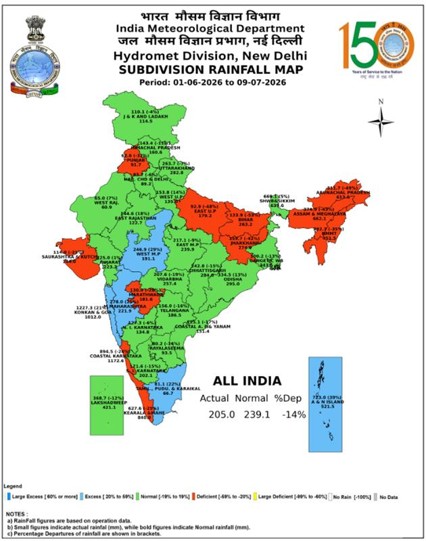
- The southwest monsoon reached Kerala on 4 June, it stalled before reaching Mumbai. Weak monsoon winds, the absence of strong low-pressure systems over the Bay of Bengal, and a weak Somali jet delayed its advance. As a result, Mumbai recorded very little rainfall through early June, while much of India experienced a significant rainfall deficit.
- By late June, the situation changed rapidly. Heavy downpours, including 225 mm of rain in just 24 hours on 24 June at Santacruz, erased much of the rainfall deficit and pushed the city’s monthly rainfall close to normal.
This sharp transition from weeks of below-normal rainfall to intense, flood-inducing downpours is a classic example of monsoon whiplash, where rainfall arrives in short, extreme bursts instead of being spread evenly through the season.
Where we stand today: From Deficit to Deluge
- Mumbai’s Santacruz observatory recorded 205 mm of rain in the 24 hours ending the morning of 2 July 2026 — the second-heaviest single-day downpour of the season, surpassed only by the 225 mm recorded on 24 June 2026.
- The city logged over 400 mm of rainfall in just the first 4 days of July, back-to-back three-digit rainfall days in the last week of June helped Mumbai close the month at 516 mm, pulling the city back close to its long-period June average after a poor first half.
- Two of Mumbai’s seven drinking-water reservoirs, Vihar and Tulsi Lake, have overflowed in the past two days, a reminder that the same rainfall stressing the city’s roads and rail lines is also replenishing the reservoirs on which the city depends on through the dry months ahead.
- Heavy rain returned to the city after a brief lull, delaying suburban train services by 25–30 minutes and causing renewed waterlogging in low-lying pockets.
In Pune district’s Pimpri Chinchwad, a large mound of garbage collapsed onto a three-storey building at Moshi being used as an administrative office, with several people still trapped in the debris — the latest reminder that monsoon risk in Maharashtra extends well beyond flooding, to unstable waste sites, ageing structures, and inadequately monitored ancillary infrastructure.
Maharashtra: Widespread Impact Beyond Mumbai
The heavy rains have affected the entire state of Maharashtra, not just Mumbai. Flooding, landslides, building collapses, and electrocutions have claimed several lives across Maharashtra, while major transport routes, including the Mumbai–Goa Highway and parts of the Mumbai–Pune Expressway, faced severe disruptions.
The IMD issued red alerts for Mumbai, Thane, Palghar, Raigad, Pune, and Satara as extremely heavy rainfall battered the region. Hundreds of trees were uprooted, flights were delayed or diverted, rail services were disrupted, and many offices shifted to work-from-home.
The widespread disruption raised concerns about the resilience of urban infrastructure and stormwater drainage systems. At the same time, meteorologists note that the 2026 monsoon reflects a growing pattern of monsoon whiplash-long dry spells followed by short periods of intense rainfall. Climate trends also indicate that extreme rainfall events are becoming more frequent across Maharashtra, increasing the risk of urban flooding in the years ahead.
Why This Matters Beyond the Headlines
What makes the current spell significant from a risk perspective isn’t just the volume of rain – it’s the compression of that volume into a few days, layered on top of high tides, saturated ground from the preceding weeks, and ageing drainage infrastructure built for a different rainfall regime. Mumbai’s stormwater systems were designed several decades ago around historical rainfall intensities that this kind of compressed, high-intensity spell now regularly exceeds. When a month’s rain quota arrives in four days, the marginal cost of each additional millimetre rises sharply – pumping stations are overwhelmed, rivers and nullahs reach capacity, and low-lying areas flood even before the rain itself lets up.
This is the core of the “monsoon whiplash” pattern: long dry spells punctuated by short, intense deluges, rather than the more evenly distributed rainfall of decades past. For businesses, infrastructure operators, and city planners, this shift changes the risk calculus — it is no longer just about total seasonal rainfall, but about resilience to short, extreme bursts.
Building Resilience: What Needs to Change
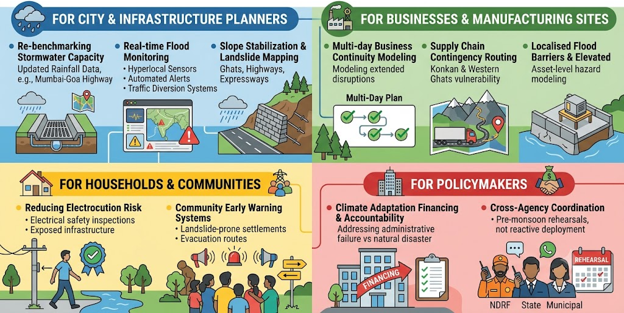
As monsoon seasons become increasingly volatile, relying on historical weather data and reactive disaster management is no longer enough to protect our cities, economies, and communities. Structural vulnerabilities along critical corridors like the Mumbai-Goa Highway and the Western Ghats demand a fundamental shift toward proactive, climate-resilient infrastructure. True resilience requires actionable strategies tailored to every level of society – from structural engineering and corporate supply chains to grassroots community safety and policy-level accountability. The infographic below outlines the essential, targeted interventions required by key stakeholders to adapt to this shifting climate reality:
The Bigger Picture
Mumbai’s July 2026 deluge is not an isolated event; rather, it is a continuation of the pattern this blog series has been tracking through the season: a slow, worrying start followed by compressed, extreme bursts that overwhelm systems built for a gentler climate. As these swings become more frequent, the cost of inaction rises with every monsoon. The choice facing the city and the state is whether adaptation investment happens proactively — or whether it continues to arrive only in the aftermath of the next flood.
This is Part 2 of RMSI’s Monsoon Whiplash series tracking Mumbai’s 2026 water crisis, from drought to deluge and its implications for business continuity and climate resilience.