
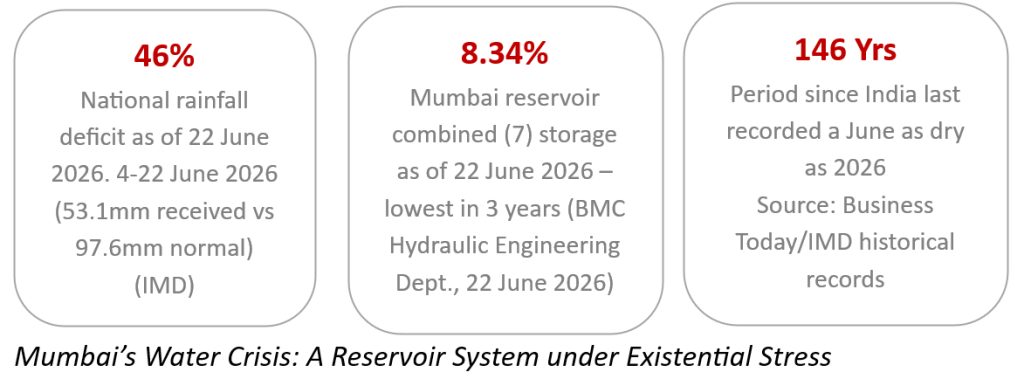
With Mumbai’s reservoirs at less than 9% capacity, a 46% national rainfall deficit, and five monsoon-suppressing atmospheric factors converging simultaneously, India’s 2026 monsoon crisis is a stress test of urban and industrial climate resilience — in real time.
India is recording its most severe June rainfall deficit in over 146 years. The country’s financial capital, Mumbai, has exhausted about 90% of its reservoir storage with weeks left before any meaningful catchment-area rainfall can arrive. And underpinning all of this is an El Niño event that climate models from NOAA to IMD are describing as potentially among the strongest in decades, a super El Niño.
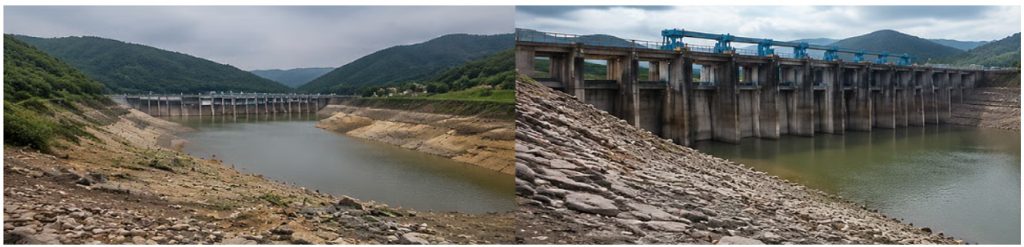
The city of over 1.2 crore people – India’s financial capital and commercial centre — draws its drinking water almost entirely from a network of seven reservoirs: Bhatsa, Upper Vaitarna, Middle Vaitarna, Modak Sagar, Tansa, Vihar, and Tulsi. These lakes are designed to fill during the monsoon months and sustain the city’s water needs through the following eleven months.
By the morning of June 22, 2026, the combined water stock in all seven lakes had fallen to 1,44,736 million litres — just 8.68% of the system’s total required capacity of approximately 14.47 lakh million litres. This is the lowest level recorded for this date in recent memory: on the same date in 2025, combined storage stood at 25.87%, and even in the relatively dry year of 2024, it was at 9.78% — still above current levels in absolute terms at comparable dates.
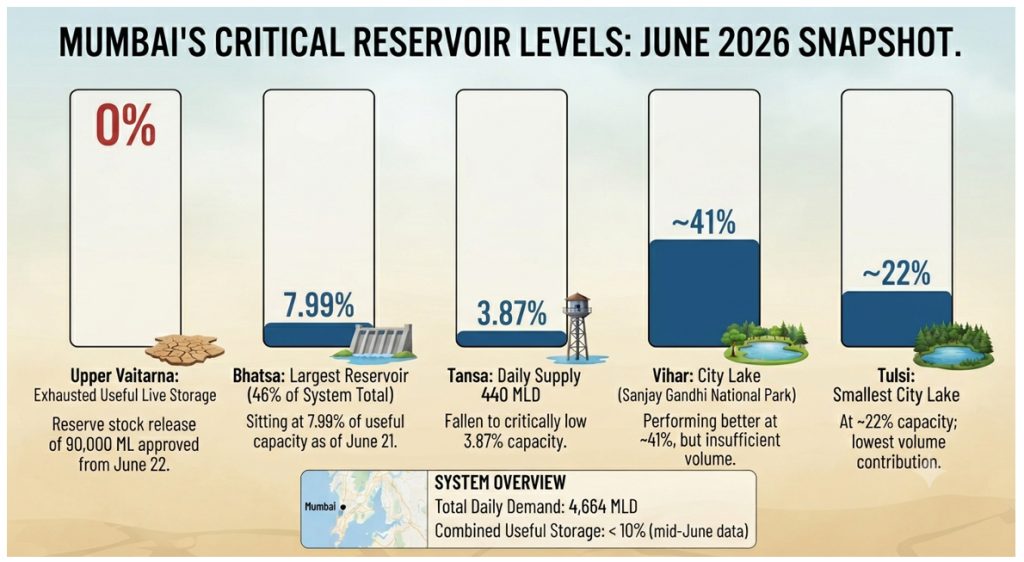
The individual reservoir picture is more granular and more alarming. The Brihanmumbai Municipal Corporation (BMC) disclosed that the Upper Vaitarna, one of the system’s major contributors, had exhausted its entire useful live storage, falling to 0% of useful capacity by early June. Bhatsa, the largest reservoir in the system (holding nearly 46% of all available useful water), was sitting at 7.99% as of June 21, 2026. Tansa sits at about 3.87% of capacity. The smaller city lakes, such as Vihar and Tulsi, are roughly at 41% and 22% of their capacities, respectively.
The BMC’s response has been systematic but necessarily reactive:
- May 15, 2026 – BMC imposes an initial 10% city-wide water supply cut as IMD signals a potentially weak monsoon season. Combined reservoir storage wasat 23% of capacity at that date.
- June 4, 2026 – Southwest monsoon arrives over Kerala – three days late and nine days after IMD’s forecast date. The Arabian Sea branch stalls almost immediately over the Konkan coast with minimal progression northward.
- June 16, 2026 – BMC reports combined reservoir storage at 10.35% and triggers additional restrictions: 20% cuts to industrial and commercial users; construction site supplies suspended; mandatory recycled water use mandated for large institutions.
- June 20, 2026 – Storage falls to 8.68% — the lowest for this date in three years. Structural analysis by the ESA Copernicus satellite imagery confirms a measurable contraction of surface-water extent compared to June 2025.
- June 23, 2026 – Storage fell further to 8.34% (1,44,736 million litres). Although the southwest monsoon advanced into Mumbai and the rest of Maharashtra, meaningful reservoir replenishment still required sustained rainfall over the catchment areas, not just the monsoon’s arrival.
As the city’s demand increasingly outpaces the capacity of its seven-lake reservoir system, currently facing a daily supply deficit of about 565 MLD, the groundwater has re-emerged and become critical. The demand has outpaced reservoir capacity, and groundwater has re-emerged as a critical but largely unregulated source of water. Rapid urbanisation and concretisation have reduced natural groundwater recharge, increasing dependence on private tanker networks. Private tanker operators now bridge much of the city’s supply gap through groundwater extraction, while nearly 40% of Mumbai’s population in informal settlements depends on groundwater as its primary water source.
Structural Paradox of Mumbai’s Water System
Mumbai receives approximately 2,300 mm of annual rainfall, among the highest of any major global city, yet it runs out of water before a delayed monsoon. The city depends entirely on seven reservoirs located 80–160 km away in the Sahyadri ranges of Nashik, so rainfall within Mumbai contributes little to usable storage. When the monsoon stalls before reaching these catchments, the city continues drawing from a finite reservoir system at a daily rate of 4,100 MLD.
Risk Management Imperative: From Crisis Response to Climate Resilience
Mumbai’s 2026 water crisis is not an anomaly; it is a preview of a structurally permanent risk. June 2026 demonstrated that water risk is now a threshold risk, capable of triggering cascading failures across operations, supply chains, and compliance with little warning. Three structural gaps now demand urgent attention:
- Water risk is still treated as operational, not climatic. Most organisations view water as a utility input, not a climate-exposed asset, even though reservoir levels, aquifer recharge, and urban water demand are all increasingly affected by delayed monsoons and El Niño.
- Scenario planning remains anchored to historical baselines that no longer hold. The 146-year record broken in June 2026 must now be treated not as a tail risk, but as a plausible near-term scenario under SSP2-4.5 and SSP3-7.0 pathways.
- Disclosure obligations are accelerating faster than underlying data systems. Organisations subject to SEBI BRSR Core, TCFD-aligned covenants, or IFRS S2 reporting must quantify physical climate risk exposures — but most lack the site-level hydroclimatic data and basin-level dependency mapping to do so credibly.
Where RMSI’s Sustainability Services Come In
RMSI’s Sustainability Services practice sits at precisely this intersection of climate science, physical risk, and institutional decision-making. The figure below explains a few of the RMSI services relevant for city infrastructure planners and industrial corporations for better climate resilience.
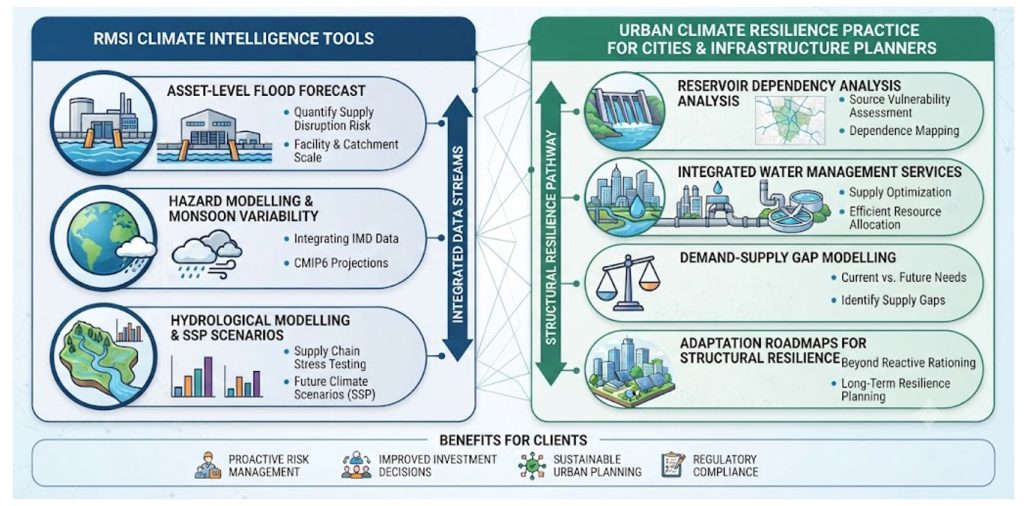
The reservoirs will eventually recover, but the drivers behind this crisis- stronger El Niño events, shifting moisture patterns, and rising water demand, are likely to persist. Organisations that integrate water risk into long-term planning will be far better prepared than those treating 2026 as an isolated event.
If you’d like to understand what this monsoon season means for your assets, operations, supply chain, and climate reporting, connect with the RMSI Sustainability Services team. We’re here to help you turn climate insights into informed, resilient decisions.
References:
- India Meteorological Department (IMD), Press Releases, Monsoon Advance Updates, June 4–24, 2026.
- Brihanmumbai Municipal Corporation (BMC), Water Engineering Department Press Notes and Official Circulars, May 15 and June 16–17, 2026. mybmc.gov.in;
- BMC Hydraulic Engineering Department, Daily Reservoir Level Reports, June 2–22, 2026.