

Telecom operators are rapidly adopting AI across network planning, operations, assurance, and customer experience. But how well any of this works comes down to something more fundamental: does the AI have access to a trustworthy digital picture of the network?
Network information tends to be spread across GIS, inventory, engineering, field, and assurance systems, each with its own version of the truth. When those sources disagree, or are missing pieces, or simply haven’t been updated, AI can still process the data. It just can’t make sense of the network.
Why AI Readiness Starts with Trusted Network Data?
High-quality data forms the foundation of every successful AI initiative. However, for telecom operators, data quality alone is not enough. AI needs network information it can trust, which includes data that accurately represents what assets exist, where they are located, how they are connected, what services depend on them, and their current state.
Trusted network data therefore means more than clean or accurate records. It means creating a reliable, connected and current representation of the network that provides AI with the context needed to generate meaningful insights and support decisions.
The Hidden Data Challenges Limiting AI Adoption.
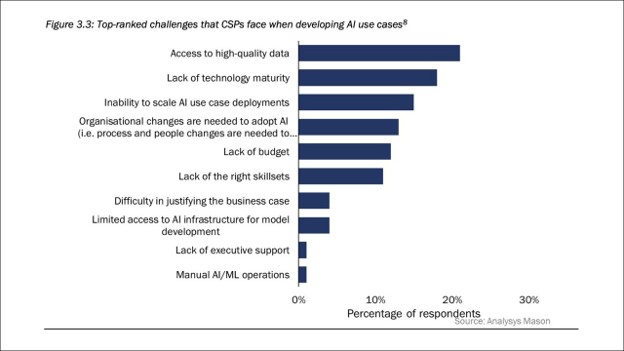
As per the research by Analysys Mason, the biggest challenge that the telco operators are facing in network automation is not having the ability to access high-quality data.
CSPs are not able to develop AI use cases due to siloes in processes and data infrastructure. Therefore, AI faces issues in working with complete and consistent data. Some of the most common challenges include:
- Conflicting and duplicate asset records
Network assets may be represented across GIS, inventory, engineering and field systems, sometimes with different identifiers, attributes or status information. Duplicate or conflicting records make it difficult to determine which information accurately represents the physical network. For AI applications, these inconsistencies can lead to unreliable analysis, inefficient planning and incorrect recommendations.
- Incomplete and outdated network records
Rapid network expansion, upgrades, and field activities can create gaps between the physical network and its digital records. Missing fibre routes, equipment details, splice information or as-built updates can prevent AI from developing a complete understanding of network conditions. Maintaining accurate records throughout the asset lifecycle is therefore critical to AI readiness.
- Disconnected GIS, inventory and operational data
Telecom network information is often distributed across GIS, inventory, engineering, field, assurance and operational platforms. Each system may provide a different view of the network, using different identifiers, structures and update cycles. When these datasets cannot be reliably connected, AI applications lack the context required to interpret network conditions accurately.
GIS plays an important role by providing the spatial and physical context of AI-powered network infrastructure. It helps in identifying where assets are located, how routes traverse the network and how infrastructure relates to premises, roads and other physical assets. Its value for AI increases when this spatial context is connected with inventory, topology and operational information.
- Incomplete physical and logical topology
AI needs to understand not only where network assets are located, but also how they are connected and dependent on one another. Incomplete physical or logical topology limits AI’s ability to assess downstream impacts, recommend network changes, identify affected services or support automated decision-making. A connected network model provides the relationships and dependencies AI needs to interpret the network as a system rather than a collection of individual assets.
What Does an AI-Ready Telecom Network Look Like?
Analysys Mason conducted another research which says that 82% of surveyed CSPs are either using or recently trialing GenAI in at least one of their network operations segments. This adoption is expected to increase over the next two years with additional 9% of the CSPs planning to implement it.
GenAI is important, but conventional AI/ML, optimisation, predictive network analytics, intent-based networking, automation and agentic AI all have roles. Telcos are able to achieve a number of network objectives; including network reliability and performance optimisation, and improving utilisation of network resources with the implementation of AI.
However, adopting AI does not automatically make a network AI-ready. Its effectiveness depends on the reliability, completeness, and usability of the underlying network data. For a telecom operator, AI-ready data should provide a reliable and connected view of the network. This means:
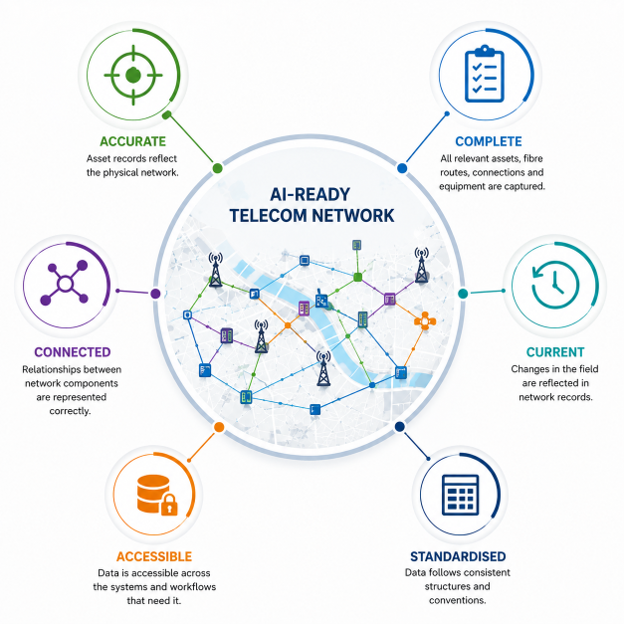
Accurate: Asset records and their attributes should reflect the physical network, including the correct location, type, and status of infrastructure.
Complete: Relevant information such as fibre routes, equipment, connections and splice details should be captured without any gaps.
Connected: Information across GIS, inventory, engineering, field, assurance and operational systems should be linked through consistent identifiers and relationships.
Current: Network records need to reflect changes made during construction, upgrades, maintenance, and field activities. Outdated information can quickly make an otherwise reliable dataset less useful.
Accessible: Network information often sits across GIS, inventory, engineering and field systems. AI applications need access to relevant information across these environments rather than relying on isolated datasets.
Standardised: Common data structures, naming conventions and attributes make information easier to integrate, validate and use across different systems.
Contextual: Network data should capture the spatial, physical, logical and service relationships between assets. This allows AI to understand the network as a connected system rather than as isolated records.
Building an AI-Ready Data Foundation
Building AI-ready telecom networks does not necessarily mean moving all network information into a single system. It requires establishing a trusted, connected view across the systems that already manage different parts of the network, including GIS, inventory, engineering, and field operations.
This begins with an honest assessment of data quality and completeness across each of these environments. Duplicate records, conflicting values, and outdated entries must be identified, reconciled against authoritative sources, and, where necessary, validated against actual field conditions.
The next step is establishing relationships between assets, their location, topology, and the operational information. This does not require moving every dataset onto a single platform. Common identifiers, standardised data models, and appropriate integration mechanisms can connect systems while allowing each to remain in place.
Most importantly, data readiness should not be treated as a one-time cleansing exercise. Processes are needed to ensure that network changes arising from construction, upgrades, maintenance and field activities continuously flow back into the systems of record. AI readiness therefore depends as much on ongoing data governance and lifecycle management as it does on initial data quality.
Operators frequently underestimate one aspect of this work: it is not a one-time cleansing exercise. Networks continue to evolve through construction, upgrades, maintenance, and field activity, and processes must be in place to feed these changes back into the systems of record on an ongoing basis. Getting the initial data right matters, but it is only the starting point. Data readiness, in this sense, is not a project that concludes but a discipline sustained through ongoing governance and lifecycle management.
Conclusion
As telecom operators accelerate AI adoption across network planning, engineering and operations, sophisticated models alone will not set one operator apart from another. What will matter more is the quality of the network context those models are working with.
That context comes from trusted network data. When asset information is accurate, spatial context is reliable, topology reflects reality, and field and operational records stay current, the result is a digital representation of the network that AI can actually interpret and act on.
GIS is central to this foundation. It supplies the physical and spatial view of the network. But GIS on its own only goes so far; its value grows considerably once it is connected with inventory, engineering, field and operational systems.
For telecom operators, becoming AI-ready therefore starts not with AI itself, but with building and continuously maintaining a trusted view of the network.