

As world leaders and representatives from more than 190 countries gathered for the 31st Conference of Parties to the United Nations Framework Convention on Climate Change (COP31) held in Antalya from 9–20 November 2026, with negotiations continuing until 22 November. Türkiye hosted the conference, with Murat Kurum serving as COP President and Australia’s Chris Bowen leading the negotiations. The conference took place against the backdrop of rising global temperatures and growing concern over the possibility of temporarily exceeding the 1.5°C warming threshold in at least one year during the 2026–2030 period, relative to the 1850–1900 pre-industrial baseline. Importantly, a single year exceeding 1.5°C does not constitute a long-term breach of the Paris Agreement’s temperature goal, which is assessed over a longer period. The need for reliable climate information, early-warning systems and climate-resilient development has therefore become increasingly important.
According to provisional UNFCCC registration data, there were 18,812 official party delegates registered for COP31 in Antalya, Türkiye (alongside 16,726 overflow participants) out of 92,934 total registered in-person participants (plus 3,335 virtual). These categories should be interpreted according to the UNFCCC’s registration definitions and should not be added together without confirming whether they overlap..
Fossil fuel combustion is the dominant source of global energy-related carbon dioxide (CO?) emissions. However, the statement that fossil fuels account for approximately 70% of total GHG emissions requires a clearly defined emissions category, reference year and authoritative source. Since the establishment of the UNFCCC process in 1992, global GHG emissions and atmospheric CO? concentrations have increased substantially, underscoring the gap between international climate commitments and actual global mitigation progress.
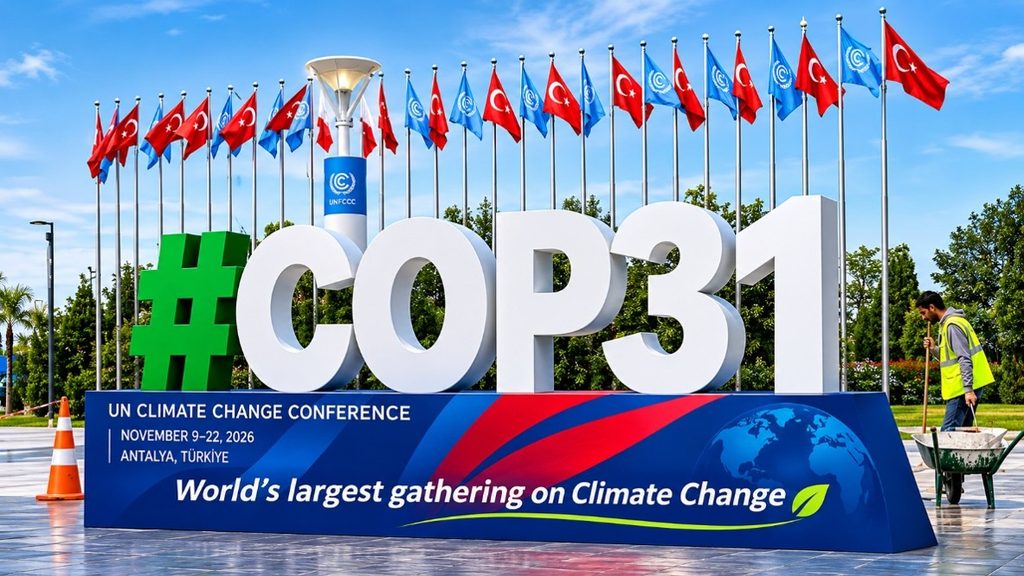
Türkiye’s Minister of Environment, Urbanization and Climate Change Minister Murat Kurum served as COP President, and Australian Climate Change and Energy Minister Chris Bowen led negotiations during COP31. The discussions took place against the backdrop of two Presidency-led roadmaps announced by Brazil during COP30 in Belém in 2025. These roadmaps addressed (i) transitioning away from fossil fuels is “urgent and inevitable” while offering “practical” steps for countries to start the process, and (ii) halting and reversing deforestation and forest degradation by 2030. These were initiatives of the Brazilian COP30 Presidency rather than formally adopted standalone decisions by all Parties. The three broad thematic areas used here to summarise the principal COP31 discussions are:
(a) Fossil Fuels & Deforestation: Building on the discussions initiated during COP30 in Belém, negotiations at COP31 addressed the implementation of pathways for transitioning away from fossil fuels, ensuring a just and equitable energy transition, and accelerating efforts to halt and reverse deforestation by 2030. However, the strength and specificity of the proposed language on fossil-fuel transition remained contentious. The disagreement over the inclusion of explicit fossil-fuel commitments contributed significantly to the failure to reach consensus on the Presidency-led cover decision.
(b) 1.5°C Warming Ambition & Climate Finance: Discussions focused on keeping the 1.5°C temperature goal within reach, addressing the possibility of temporary temperature overshoot, strengthening adaptation measures and scaling up climate finance. The launch of the second Global Stocktake (GST2), a key mechanism under the Paris Agreement for assessing collective progress towards achieving its objectives, was also an important development. Although successive Presidency-led draft texts addressed the prospect of global warming exceeding 1.5°C, the proposed cover decision was not adopted. Furthermore, a single calendar year exceeding 1.5°C does not, by itself, establish a long-term breach of the Paris Agreement’s temperature goal, which is assessed over a multi-decadal period.
(c) Equity, Climate Justice, and Participation: Climate Justice and Participation: Developing countries, including India, emphasised equity, climate justice and the principle of Common but Differentiated Responsibilities and Respective Capabilities (CBDR-RC), alongside the need for predictable climate finance, technology transfer and enhanced adaptation support. Differences between developed and developing countries over climate finance, mitigation responsibilities and the interpretation of equity remained important negotiating challenges. The level and nature of United States government participation should be described precisely rather than characterising the country simply as absent. These discussions also took place amid wider geopolitical tensions and competing international priorities.
India’s Position on Climate Multilateralism and Climate Finance:
India reaffirmed its commitment to climate multilateralism, India’s Position on Climate Multilateralism and Climate Finance. Emphasising the importance of multilateral cooperation, India underlined that the UNFCCC and its Paris Agreement remain the most inclusive platforms for addressing climate change, where all Parties have an opportunity to participate in decision-making, taking into account their respective national circumstances and development priorities. India highlighted equity, a just transition and adaptation as essential pillars of effective climate action, particularly for developing countries and the wider Global South.
India, working with the G77 and China, BASIC India, working with the G77 and China, BASIC (Brazil, South Africa, India and China), and the Like-Minded Developing Countries (LMDC) negotiating group, emphasised the need for developed country Parties to fulfil their financial obligations under Article 9.1 of the Paris Agreement, which requires developed country Parties to provide financial resources to assist developing country Parties with respect to both mitigation and adaptation. India and other developing countries also stressed the importance of predictable, accessible, adequate and predominantly public climate finance, with a strong preference for grant-based and concessional resources, rather than excessive reliance on commercial loans that could increase debt burdens.
During the COP31 negotiations, a proposed target of USD 120 billion per year in adaptation finance by 2035, advocated by developing countries, was removed from a subsequent Presidency-led draft cover text. This reflected continuing differences over the scale, sources, accessibility and delivery mechanisms of adaptation finance. The discussions also highlighted the need to translate the commitment to substantially scale up adaptation finance, including the objective of tripling adaptation finance by 2035, into clearly defined implementation pathways, with transparent baselines, interim milestones and measurable financial delivery. However, the proposed USD 120 billion figure should not be presented as an adopted COP31 commitment.

COP31 Negotiations: Energy Transition, Climate Finance and India’s Engagement:
COP31 discussions were marked by differences between developed and developing countries over climate finance, trade measures and mitigation responsibilities. The Presidency’s electrification agenda aimed to accelerate the shift towards electricity-based energy systems. However, electrification alone does not ensure decarbonisation; its benefits depend on renewable power generation, modernised grids, energy storage and improved efficiency.
Current-policy projections indicate that global warming could reach approximately 2.8°C above pre-industrial levels by 2100, depending on policy assumptions and modelling methods. This highlights the need for faster renewable energy deployment, reduced dependence on unabated fossil fuels, just transition measures, adequate climate finance and ecosystem protection.
Climate finance remained a major point of disagreement. African countries called for accessible adaptation finance and replenishment of the Green Climate Fund. Nepal and Bhutan highlighted mountain-related risks, including glacier retreat, glacial lake outburst floods, changing river flows and threats to livelihoods. The central challenge was translating financial commitments into predictable and accessible resources.
COP31 negotiations extended beyond the scheduled closing date of 20 November and concluded on 22 November 2026 without consensus on the overarching Presidency-led cover decision. However, agreements were reached on several other negotiating agenda items. Disagreements mainly concerned fossil-fuel transition language and climate-finance commitments.
Panama’s Environment Minister, Juan Carlos Navarro, submitted an open letter outlining eight conditions for supporting the outcome, including a proposed cap on global oil production. Separately, seven countries reportedly supported targeted levies on high-emission sectors such as aviation. These were proposals, not agreed COP31 decisions.
India’s Participation and Climate Priorities:
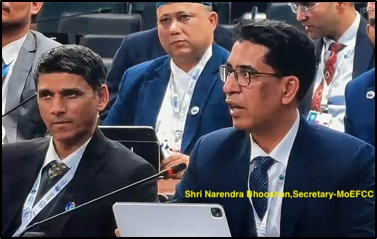
India’s delegation was led by Union Minister for Environment, Forest and Climate Change, Shri Bhupender Yadav. Senior officials included Shri Narendra Bhooshan, Secretary, MoEFCC, and Dr. Amandeep Garg and Shri Ashutosh Agnihotri, Additional Secretaries, MoEFCC.
India’s priorities included climate equity, adaptation, technology transfer, predictable finance and protection of developing countries’ development needs. COP31 recorded approximately 92,934 registered in-person participants and 3,335 virtual participants, according to provisional figures.
A key challenge was moving from climate pledges to implementation through finance, technology and capacity building. Negotiators also addressed the COP30 call for efforts to triple adaptation finance by 2035, although funding sources and delivery arrangements remained areas of discussion.
The World Bank Group and other multilateral development banks can support renewable energy, grid modernisation, storage, energy efficiency and climate adaptation through public, concessional and blended finance. Such investments should also consider debt sustainability, affordability and the needs of developing countries.
COP31’s implementation agenda emphasised converting climate commitments into bankable projects by strengthening project preparation, improving access to finance and mobilising public and private investment.
Global Electricity Demand and Electrification:
The International Energy Agency reports that global electricity demand has grown faster than overall energy demand since 2019, driven by industrial electrification, increasing use of appliances, air conditioning, heat pumps, electric vehicles and data centres. Rising temperatures are also increasing cooling-related electricity demand. These trends underline the growing importance of electricity in the global energy system.
COP31’s electrification agenda focused on accelerating the transition towards electricity-based energy systems. However, electrification does not automatically result in decarbonisation. Its climate benefits depend on the availability of low-emission electricity, modern transmission and distribution networks, energy storage and improved energy efficiency. Governments therefore need to complement electrification with renewable energy deployment, fossil-fuel transition strategies, just transition measures, climate finance and ecosystem protection.
Current-policy warming projections of approximately 2.8°C by 2100 should be attributed to a specific assessment and scenario. Climate finance remained a major negotiating issue, with African countries calling for greater adaptation support and replenishment of the Green Climate Fund. Nepal and Bhutan highlighted mountain-related climate risks, including glacier retreat, glacial lake outburst floods and changing river flows.
COP31 Negotiations and Key Issue:
On November 22, 2026, COP31 Turkish and Australian Presidencies continued efforts to secure agreement on the proposed Presidency-led cover decision, following negotiations that extended beyond the scheduled closing date. Discussions remained divided over fossil-fuel transition language, climate finance and the level of ambition required for implementation. The Presidency-led cover decision was not adopted because consensus could not be reached. However, COP31 delivered agreements on several other negotiating agenda items, including just transition, climate finance, adaptation, mitigation and technology. Key elements of declaration included:
- 1.5°C temperature goal: Draft negotiating text referred to the risk of exceeding the 1.5°C threshold. However, a temporary exceedance in an individual year should not be interpreted as a formal breach of the Paris Agreement’s long-term temperature goal, which is assessed over a longer period.
- Fossil-fuel transition: Draft texts referred to earlier COP commitments on transitioning away from fossil fuels. However, the Presidency-led cover decision did not secure consensus on a stronger fossil-fuel transition roadmap.
- 35-by-35 electrification initiative: The Presidency promoted a voluntary initiative to increase electricity’s share of global final energy consumption to 35% by 2035. This should not be presented as a binding commitment adopted by all Parties.
- Adaptation and mountain resilience: Discussions addressed the need to scale up adaptation finance and recognise climate risks in mountain regions. The proposed USD 120 billion annual adaptation-finance target was not retained in the final Presidency-led draft.
Climate Change and the 1.5°C Goal:
Limiting global warming to 1.5°C is critical to reducing climate-related risks. Rising temperatures are contributing to more intense heat extremes and changing the frequency and severity of several climate hazards, including heavy precipitation, droughts and wildfire-conducive conditions.
The world is at risk of temporarily exceeding 1.5°C in individual years. However, this is different from a sustained, long-term exceedance of the Paris Agreement temperature goal. Limiting long-term warming requires rapid and sustained reductions in global greenhouse gas emissions, including substantial reductions in carbon dioxide and methane emissions.
The Presidency’s electrification initiative proposed increasing electricity’s share of global final energy consumption from approximately 23% to 35% by 2035. Achieving this transition will require renewable energy capacity, grid modernisation, storage, demand-side management and electrification of transport, buildings and suitable industrial processes.
On adaptation finance, COP30 in Brazil called for efforts to triple adaptation finance by 2035. COP31 discussions focused on implementation and access to finance, but the proposed USD 120 billion annual target should not be described as an adopted COP31 commitment.
Sectoral Pledges: Alongside the main cover decision, COP31 saw parallel announcements and declarations covering health impacts of fossil fuels, food loss and waste reduction, wildlife protection, and electrification. Other Notable Declarations & Compacts arrived at COP31 were:
- COP31 Antalya Compact for Energy Efficient Buildings:Introduced with the Global Alliance for Buildings and Construction, setting a voluntary global goal to cut operational building energy intensity by at least 25% by 2035 from 2020 levels.
- Wildlife for Climate Declaration:Endorsed by 25 countries to integrate wildlife protection and restoration into climate action.
- Healthy Transition Declaration: A political pledge led by Spain with six initial signatories linking fossil fuels to public health harm and calling on the WHO to guide a transition away from them.
- COP31 Declaration on Reducing Food Loss and Waste: Calls on national governments to include food loss and waste reduction in climate plans.
- India & Developing Nations: India emphasized equity, climate justice, and fulfilling existing climate finance commitments under the summit theme of “Dialogue, Consensus and Action”.
India’s Climate Priorities and Challenges:
India emphasised climate equity, climate justice, the principle of Common but Differentiated Responsibilities and Respective Capabilities (CBDR-RC), and the need for predictable climate finance and technology support. It also highlighted the importance of balancing climate action with poverty reduction, energy security and sustainable economic development.
According to NITI Aayog’s assessment, India’s transition towards net zero by 2070 could require cumulative investment of approximately USD 22.7 trillion, with an estimated financing gap of USD 6.5 trillion. These are scenario-based cumulative estimates through 2070 and should not be interpreted as immediate funding requirements or guaranteed investment opportunities.
India is increasingly facing economic and fiscal impacts associated with floods, cyclones, heatwaves and other extreme weather events. According to Germanwatch’s Climate Risk Index 2027, India ranked tenth among the countries most affected by extreme weather events during 1996–2025. The assessment reported 436 events, approximately 78,000 fatalities, more than 1.2 billion people affected and economic losses exceeding USD 170 billion.
These figures represent reported impacts associated with extreme weather events; they should not be interpreted as losses exclusively attributable to anthropogenic climate change.
India’s disaster-risk management priorities include strengthening climate-resilient agriculture, water-resource management, urban infrastructure and ecosystem protection. Key interventions include improved heatwave and flood early-warning systems, climate-resilient crop varieties, community seed banks, weather-based agro-advisories, diversified livelihoods, flood-resilient housing, improved urban drainage and efficient cooling systems.
RMSI’s relevant contribution can be described in terms of GIS-based exposure databases, geospatial risk assessment, climate-risk modelling, hazard mapping and location-specific decision-support tools. These capabilities can support climate adaptation planning, disaster preparedness and investment prioritisation.
Role of other RMSI Bus:
India’s total forest and tree cover was reported at 8,27,356.95 km², representing 25.17% of its geographical area in the India State of Forest Report 2023. This includes 7,15,342.61 km² of forest cover and 1,12,014.34 km² of tree cover. According to FAO’s Global Forest Resources Assessment 2025, India ranked ninth globally in forest area and third in annual net forest gain.
The National Mission for a Green India, launched in February 2014 under the National Action Plan on Climate Change, aims to enhance forest and tree cover, restore degraded ecosystems, improve ecosystem services and strengthen forest-based livelihoods. Its implementation also supports carbon sequestration, biodiversity conservation and climate resilience.
In the industrial sector, India’s steel industry faces the challenge of reducing emissions while maintaining production growth. Tata Steel, in collaboration with Utility Global, announced plans to undertake engineering studies for a proposed 10-tonne-per-day hydrogen-production facility at its Kalinganagar plant in Odisha. The project is intended to explore hydrogen production using steel plant off-gases and remains subject to the relevant engineering studies and investment decision.
In the power sector, India’s non-fossil installed capacity reached approximately 55% of total installed capacity as of July 2026. However, installed capacity should be distinguished from actual electricity generation, which depends on resource availability, plant utilisation, grid integration and storage. Continued investment in transmission, distribution, storage and domestic clean-energy manufacturing will be important for the energy transition.
Waaree Energies has proposed a green ammonia project in Kakinada, Andhra Pradesh, with a planned capacity of 1.2 million tonnes per annum and an announced investment of ?15,000 crore. The proposal should be described as a planned project, with investment and implementation subject to the company’s internal approvals.
India also has significant potential to develop compressed biogas from agricultural residues, organic waste and other biomass resources. The estimated production potential and number of commissioned projects should be supported by the latest official data, with clear definitions of project approval, construction and commercial operation.
In aviation, India has established indicative sustainable aviation fuel blending targets of 1% in 2027, 2% in 2028 and 5% in 2030, initially for international flights. These targets should not be confused with a confirmed national mandate of 40% SAF blending by 2040. Sustainable aviation fuel can contribute to reducing lifecycle greenhouse gas emissions, subject to feedstock sustainability, production pathways and lifecycle assessment.
Just Transition and Adaptation Finance:
COP31 negotiations highlighted continuing differences over the institutional arrangements and implementation of a global just transition mechanism. However, it would be inaccurate to state that COP31 failed to achieve any progress on just transition, as the conference reached an agreement on this negotiating item.
Discussions on the Global Goal on Adaptation and climate finance also reflected differences over funding baselines, delivery arrangements, accessibility and responsibilities. The key challenge remains translating financial commitments into predictable, additional and accessible resources for developing countries, particularly those facing high climate vulnerability.